Business Challenges
We will first talk about business challenges: the performance of your information system is the performance of your company. Indeed, for information at Amazon An additional latency of 100 ms is 1% less CA.
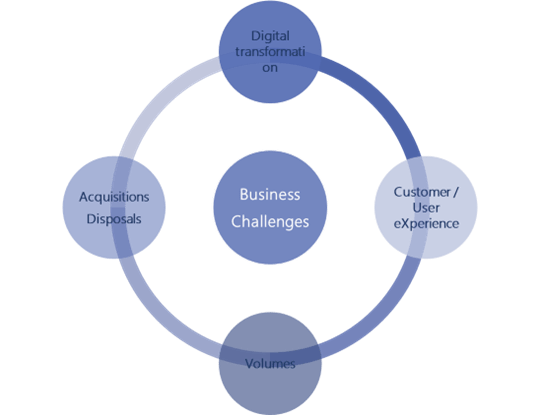
When we talk about business challenges, we are talking about digital transformation: companies now want to implement a digital transformation as part of the reform of their value proposition. Concretely this means more interfaces between the different systems, of course this digital transformation must have a strong impact on the Customer/ User experience (CX, UX). Obviously, the business challenges are issues of volume that is growing because systems have more users, histories, and acquisitions/ disposals of businesses: the market is dynamic and such operations are common.
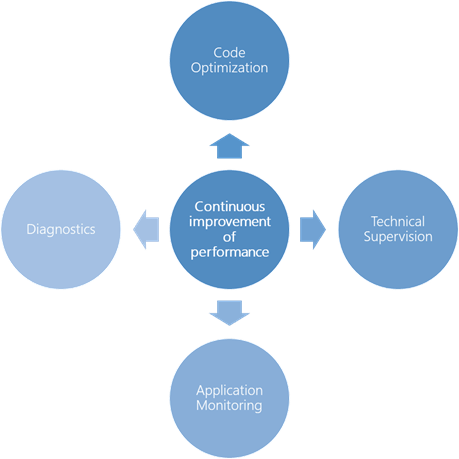
This brings us to the need for continuous performance improvement.
Technical supervision corresponds to the different components on Prem and in the cloud managing the platforms. What is added to the application supervision to the 4-dimensional tour that are the HMI, interfaces, reports, batches.
Performance problems will trigger diagnostics: that is, we will collect all the information to identify the blocking points. It is especially important when you perform troubleshooting sessions that you have all the elements concerning technical supervision, so that when the business returns you a performance pb, you could indicate at what time, what happened on the system.
All this to trigger later code optimizations to improve performance.
Why Performance Benchmarks?
At the IT level, it is important to focus on performance benchmarks. What are the reasons for performing performance test benchmarks:
- You ensure that the solution implemented will be able to manage the actual workload.
- Simulate the thousands of users you will have in 6 months for example,
- At the start it may be that you have few data, but you want to see the evolution in 3 years: you have an extraordinarily rapid growth of the database, and you make sure it will work as well with this volume of data.
The process set up for performance will ensure that your solution is scalable, that it can meet business performance objectives. This will help you identify and search for performance issues during implementation.
But also to identify the optimization points in order to bring maximum value to the business and this will give you the assurance that the solution you have built will allow the client to achieve its business objectives and project on a simulation of the objectives business that could be, for example, the number of transactions you want to make in 2 or 3 years, the number of users to come…
Platform Scalability
The process put in place to improve performance is there to ensure that your system, is scalable over time.

When we create a solution, we add building blocks to our platform. When there is a performance, the root cause may come from different areas.
Microsoft is committed to providing a scalable platform to manage your solution. An agile infrastructure that consists of servers, BDD and in addition the standard solution
During the implementation, we add additional building blocks. We use different devices to access D365FO, different browsers that may be obsolete, there are customizations, third party solutions that will be added and may not be adapted for optimal performance.
Data is also involved: large volumes of data can lead to performance issues. Interfaces such as reports if they are poorly designed overall also have a massive impact on performance. We also have users who as you know can make mistakes in using D365FO and generate performance problems,
We can finally have business processes are not optimized: ex from importing items during the day when this is not necessary, replanning at night allows to regain the performance of the system during the day, saving resources and being more efficient.
Microsoft is committed to providing a scalable platform, but it is the responsibility of implementation teams to ensure that this scalability is not broken.
 D365FOAdviceTips
Leave a comment