
- What Is the Model Context Protocol (MCP)?
- What MCP Enables
- Why MCP Matters for AI Agents
- The First-Generation Dynamics 365 MCP Server (Static Tools)
- Introducing the New Dynamic MCP Server for Dynamics 365 ERP
- How It Works: A New Interaction Pattern
- Security and Governance Built In
- Support for ISV and Custom Features
- MCP vs API: Why Both Matter
- Why This Matters for the Future of ERP Automation
- Final Thoughts
Generative AI is reshaping how organizations operate by enabling a new paradigm of interaction: natural language–driven workflows. Instead of navigating complex systems or writing code, users can now instruct AI agents that understand business logic, execute tasks, and orchestrate end-to-end processes.
Now imagine this: You create an AI agent, connect it to your ERP, and it instantly performs actions inside your system — pulling data, updating forms, executing business logic — all through natural language. No manual input. No navigating menus. No specialized tools.
That future is now within reach.
Microsoft has released a new Model Context Protocol (MCP) Server for Dynamics 365 Finance, currently in public preview. This release is a major milestone for transforming D365 Finance into a headless ERP that AI agents can use autonomously and safely.
This article explains how MCP works, why it matters, and how the new Dynamic MCP Server changes everything.
What Is the Model Context Protocol (MCP)?
MCP is an open standard — originally introduced by Anthropic — that defines how applications provide context to AI models through structured, secure tools. Microsoft has adopted and extended this standard across its ecosystem, including Dataverse and now Dynamics 365 ERP.
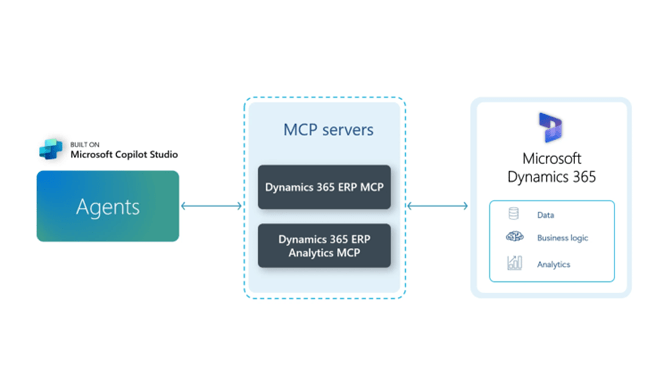
In simple terms:
MCP is to AI what USB-C is to hardware.
A universal, flexible, plug-and-play interface.
What MCP Enables
AI agents using MCP can:
- 🔐 Securely access backend systems using OAuth
- 🧩 Discover available tools dynamically
- 📄 Interpret actions using OpenAPI specifications
- 🧠 Understand what they can do — and when
Think of MCP as a user manual for AI agents, explaining how a business application works, what actions it supports, and how to perform them safely.
Why MCP Matters for AI Agents
For AI agents to deliver real business value, they must understand more than raw data. They need:
- Business structures
- Application logic
- User permissions
- Workflows and constraints
- Contextual decision-making
MCP provides this structured context.
Without MCP, an AI model cannot safely interact with enterprise applications like Dynamics 365 Finance. With MCP, it can navigate, reason, and execute actions — much like a human user — but at machine speed.
The First-Generation Dynamics 365 MCP Server (Static Tools)
Microsoft previously shipped a static MCP server with a limited set of predefined actions — for example:
- Find Vendors
- Create Transfer Order
- Read Inventory
- Convert Purchase Requisitions
It exposed 13 supply-chain-oriented tools. While valuable for experimentation, the static approach had limitations:
- Tools were fixed and hardcoded
- Adding new capabilities required redeployment
- It couldn’t scale to the thousands of features in D365
- Customizations were difficult to support
As organizations began building more complex agents, the need for a dynamic, flexible system became clear.
Introducing the New Dynamic MCP Server for Dynamics 365 ERP
The new D365 MCP Server represents a complete architectural shift.
It moves from a small static set of tools to full dynamic UI-level access.
🚀 Agents can now do almost anything a real user can.
This includes:
- Opening any form (standard, ISV, or custom)
- Setting field values
- Triggering actions or workflows
- Saving and submitting forms
- Navigating between modules and workspaces
Instead of hardcoded APIs, the agent interacts with the actual ERP application — just like a human — but via structured server-side APIs.
This unlocks millions of potential ERP operations instantly, without custom integrations.
How It Works: A New Interaction Pattern
The Dynamic MCP Server exposes a set of meta-tools that let the AI navigate the system:
- Open Form
- Find Menu Item
- Get View Model
- Set Field Value
- Trigger Action
- Save Form
From these primitives, any task becomes possible — from updating vendor records to releasing purchase orders or reconciling invoices.
No more static tools. No more connectors to maintain.
The server automatically understands:
- Custom fields
- ISV extensions
- Personalized forms
- User security roles
- Custom processes and logic
If it’s accessible in the UI, it’s accessible to the agent.
Security and Governance Built In
The Dynamic MCP Server respects:
- Entra ID authentication
- Dynamics 365 user roles
- Duties and privileges
- Custom object permissions
An AI agent can only perform actions that its assigned D365 user role is allowed to perform.
For example:
- A Purchasing Agent can discover only purchasing-related menu items.
- A Finance Clerk can only access finance forms and data.
The view model returned to the agent mirrors exactly what the human user would see — no more, no less.
This prevents privilege escalation and ensures predictable agent behavior.
Support for ISV and Custom Features
A major advantage:
✔ ISV forms require no changes
✔ Customizations are automatically supported
✔ Personalizations are respected
✔ Extensions inherit all UI logic
If a feature is visible in the UI, the server exposes it.
If something is too complex or hidden, developers can still create a dedicated AI tool to guide the agent.
MCP vs API: Why Both Matter
A frequent question is: “How is MCP different from an API?”
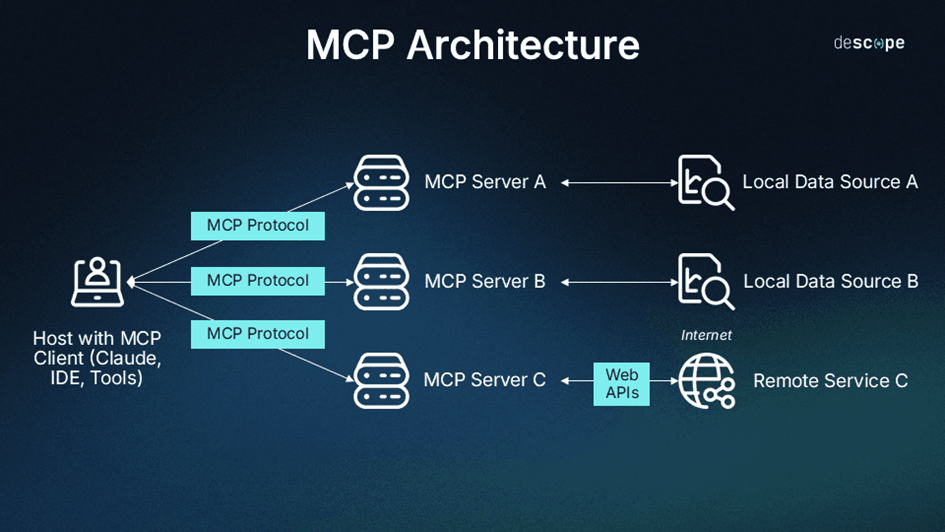
Here’s the simplest comparison:
API = Traditional USB-C Port
- Designed for a specific function
- Rigid, predictable, predefined
- Great for structured tasks
MCP = Smart USB-C Port
- Adapts to the connected device
- Discovers capabilities dynamically
- Supports complex, contextual workflows
- Enables multi-step reasoning
APIs don’t go away — in fact, MCP tools often call APIs behind the scenes.
But MCP elevates them by introducing:
- Dynamic tool discovery
- Context awareness
- Agent reasoning and orchestration
APIs tell machines what to do.
MCP enables machines to understand why and how.
Why This Matters for the Future of ERP Automation
With the new Dynamic MCP Server, Dynamics 365 Finance becomes a truly AI-native ERP.
This unlocks:
- Autonomous finance workflows
- Intelligent supply chain orchestration
- Dynamic data maintenance agents
- Natural language user interfaces
- Cross-agent collaboration
- Low-code AI automation at ERP scale
And all of it happens without:
- custom connectors
- manual integrations
- redeployments
- rigid API constraints
Microsoft has effectively given D365 Finance a universal, future-proof interface for AI.
Final Thoughts
The Dynamic MCP Server represents one of the most significant evolutions in the Dynamics 365 platform. By opening up the entire ERP UI layer to AI agents — safely and dynamically — Microsoft enables a new era of automation, where:
- Users speak.
- Agents understand.
- Systems act.
- Processes flow.
- Business accelerates.
If your organization is exploring AI automation, the new MCP server is a foundational technology that will shape how enterprise systems are used for years to come.
 D365FOAdviceTips
Leave a comment