- Introduction
- From Synchronization to Reaction
- Business Events: Speaking the Language of the Business
- Data Events: Flexible but Talkative
- Business Events vs Data Events: An Architectural Choice
- Event-Driven Integration with Power Platform
- Key Takeaways
- Conclusion
Introduction
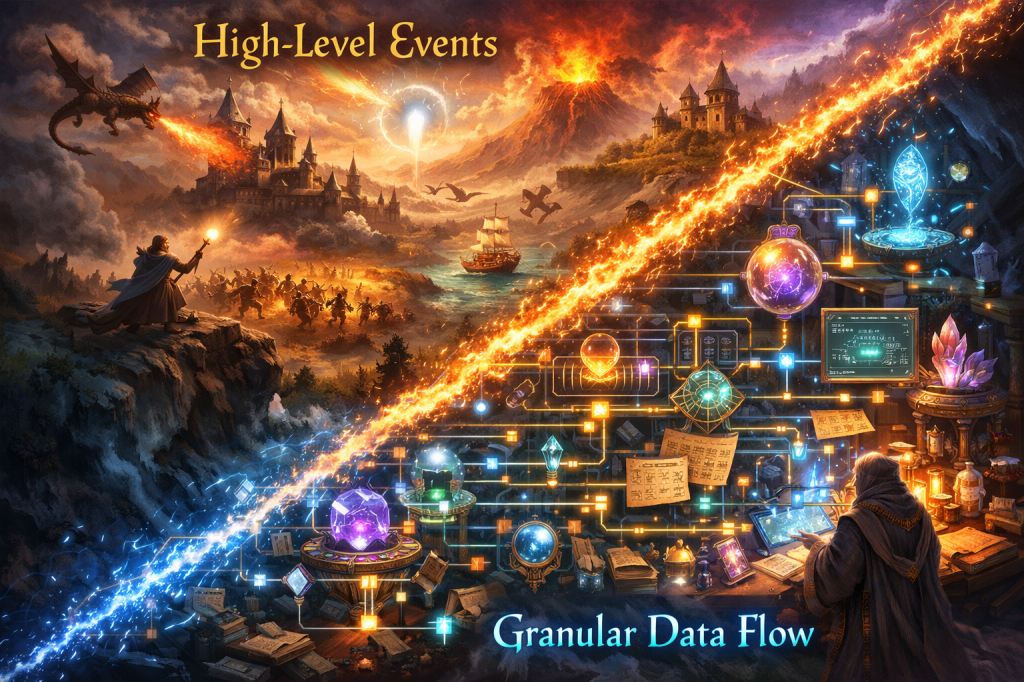
After years of designing integrations focused on data synchronization, many architects are starting to challenge the core question: what if moving data is not the goal anymore? Event-driven integration offers a compelling alternative. Instead of synchronizing data sets, systems react to what actually happens, in real time. In many business scenarios, timing matters far more than storage.
From Synchronization to Reaction
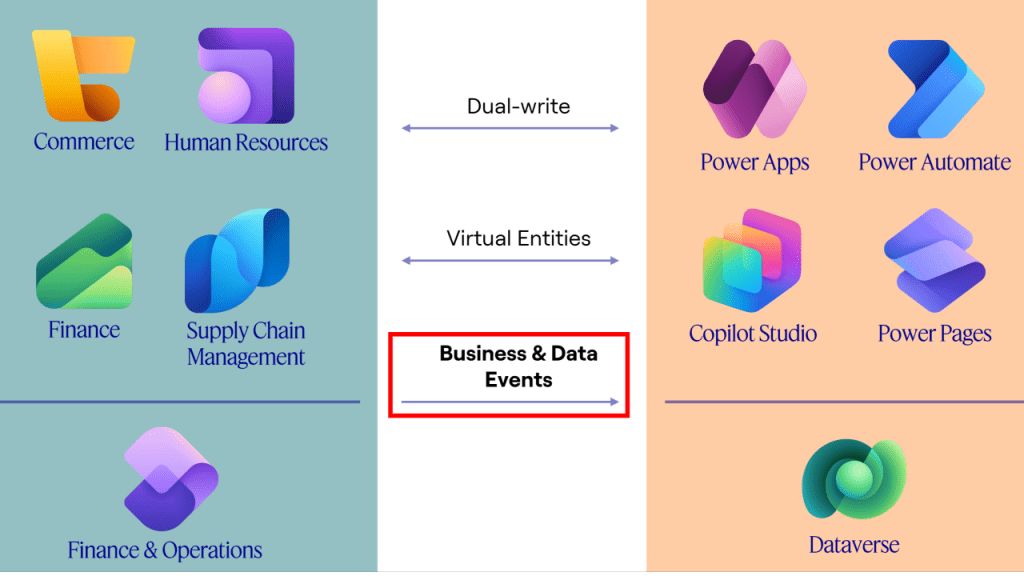
In Dynamics 365 Finance & Operations, event-driven integration is primarily enabled through Business Events and Data Events. Although they may appear similar at first glance, they serve fundamentally different purposes. Understanding this distinction is essential for designing scalable and maintainable integrations.
Business Events: Speaking the Language of the Business
Business Events represent meaningful business processes. They are emitted when something important occurs in the system, such as a sales order confirmation, an invoice posting, or a shipment update. These events are business-oriented, clearly defined, and designed specifically for integration scenarios.
One of their key strengths is their native integration with the Power Platform. Business Events can be consumed directly by Power Automate or Copilot Studio, enabling real-time orchestration without mandatory Azure middleware. However, the catalog of out-of-the-box Business Events remains limited, and extending it requires X++ development.
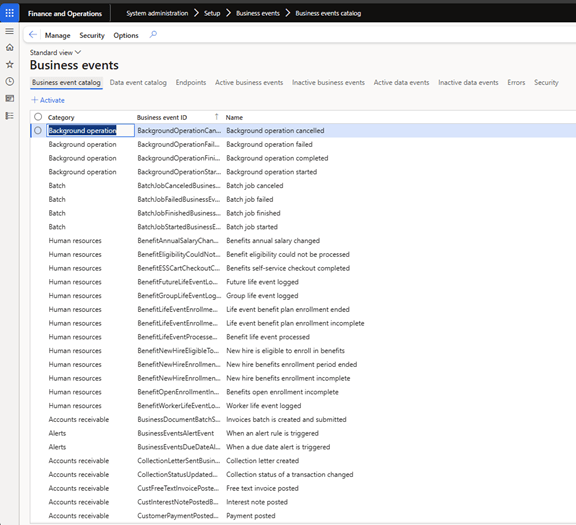
Another important consideration is payload. Business Events usually act as signals rather than data carriers. They indicate that something happened, after which downstream systems typically retrieve the required data from Finance & Operations based on the context provided by the event.
Data Events: Flexible but Talkative
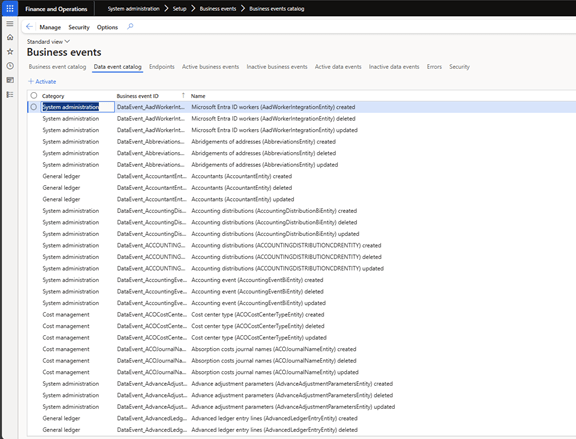
Data Events operate at a lower technical level. They are triggered by insert, update, or delete operations on specific tables or entities, independent of the underlying business meaning. This makes them extremely flexible, but also less explicit from a business perspective.
Data Events are typically used when no suitable Business Event exists, or when very fine-grained control is required. Like Business Events, they usually act as signals, requiring additional API calls to retrieve complete datasets. Their main drawback is noise: even minor changes can trigger events, leading to unnecessary downstream processing if not properly filtered.
Business Events vs Data Events: An Architectural Choice
The difference between Business Events and Data Events is not merely technical; it is architectural. Business Events describe what happened in business terms and provide a clean, supported integration surface. Data Events, by contrast, simply indicate that something changed, offering maximum flexibility at the cost of clarity.
Event-Driven Integration with Power Platform
Event-driven patterns align naturally with a Power Platform-first strategy. By combining events with Power Automate or Copilot Studio, organizations can trigger real-time flows, orchestrate logic outside Finance & Operations, and retrieve only the data that is actually required. This approach significantly reduces custom code and batch-based integrations.
Key Takeaways
– Business Events are business-centric and easier to reason about
– The number of out-of-the-box Business Events is limited
– Extending Business Events requires X++ development but often leads to cleaner architectures
– Events act primarily as signals, not as full data carriers
– Data Events are powerful but inherently noisy and require strong governance
Conclusion
Event-driven integration introduces a different mindset. Instead of asking how data should be synchronized, the real question becomes: what should trigger the process? In most scenarios, Business Events offer the best architectural balance, providing clarity, business alignment, and long-term maintainability. Data Events still have their place, but must be used with caution. When events are treated as signals rather than data pipelines, organizations can build integrations that are not just faster, but smarter.
 D365FOAdviceTips
Leave a comment