- The May 2027 Deadline
- Why RSAT Is Reaching Its Limits
- The Alternative: AI + MCP for D365 FINANCE & SCM
- Reporting and Traceability: Email + Report Files
- Topics Every Organization Must Address Before Switching
- Closing Thought
The May 2027 Deadline
Microsoft has confirmed — via Viva Engage and direct communications — that the Regression Suite Automation Tool (RSAT) will be deprecated on 15 May 2027. After that date, no updates and no support will be provided.
Notably, Microsoft has not announced a like-for-like replacement. Instead, the message points toward modern testing approaches and broader end-to-end automation. For customers, partners, and ISVs who have built years of investment around Task Recorder and RSAT pipelines, this is more than a tooling swap — it is an invitation to rethink the entire non-regression strategy.
The underlying question is sharp:
Is the ERP industry moving away from scripted testing toward AI-driven testing — tools capable of generating, adapting, and maintaining test scenarios on their own?
The answer, increasingly, is yes. And the emergence of Model Context Protocol (MCP) servers around Dynamics 365 Finance & Operations makes this shift concrete rather than theoretical.
Why RSAT Is Reaching Its Limits
RSAT served us well, but its constraints are well known:
- Brittle to UI changes — every form update risks breaking the recordings.
- Heavy maintenance — each release wave (twice a year) typically triggers a cycle of repair work.
- Linear scripting — recorded steps don’t understand business intent; they replay clicks.
- Limited reporting — results land in Azure DevOps test plans, but business-readable evidence (CR documents, executive summaries) still has to be built manually.
- No self-healing — when a label changes or a control moves, the script fails rather than adapts.
In a world where D365 FINANCE & SCM evolves continuously, brittle scripts become a tax on the upgrade cadence rather than a safety net.
The Alternative: AI + MCP for D365 FINANCE & SCM
The combination of Large Language Models and MCP servers opens a fundamentally different way of running non-regression cycles.
What an MCP brings to the table
An MCP server is a standardized bridge between an AI agent and a business system. For D365 FINANCE & SCM specifically, an MCP can expose:
- Data services: read/write entities (customers, vendors, sales orders, journals, postings).
- Process orchestration: trigger batch jobs, period-end routines, MRP runs.
- Metadata introspection: forms, fields, security roles, workflows.
- Reporting hooks: fetch financial reports, inventory snapshots, audit trails.
An AI agent connected to these MCPs can describe a test in natural language, execute it via the API surface (not the UI), validate outcomes against expected values, and adapt when the underlying form or label changes.
What changes versus RSAT
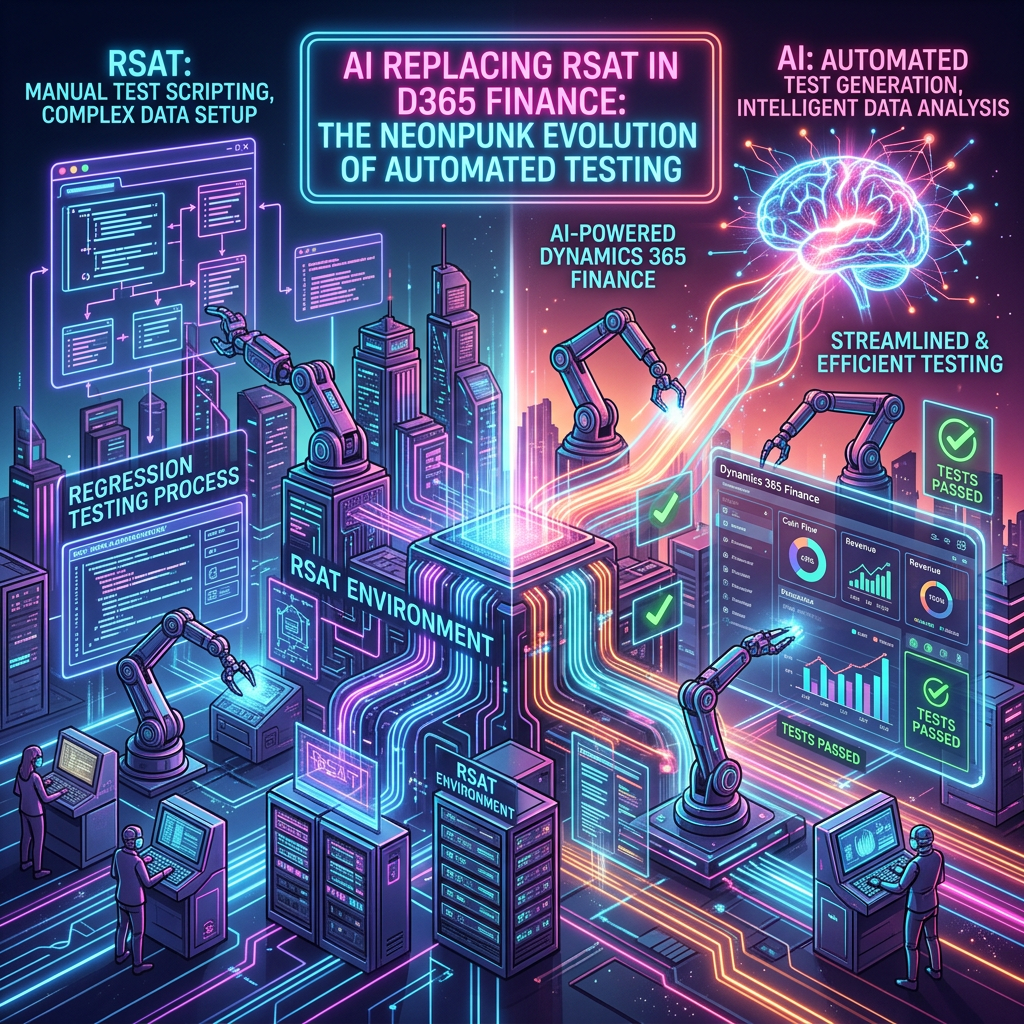
| Dimension | RSAT (today) | AI + MCP (tomorrow) |
| Test definition | Recorded clicks (.axtr) | Natural-language scenarios |
| Resilience | Breaks on UI changes | Self-adapts via APIs / metadata |
| Coverage | One scenario = one recording | One prompt = N variants generated |
| Maintenance | Manual re-recording | AI proposes the fix |
| Evidence | Pass/fail logs | Auto-generated CR (Word/Excel/PDF) |
| Skill profile | Functional consultant + scripter | Functional consultant + prompt engineer |
Reporting and Traceability: Email + Report Files
A credible replacement strategy is not only about running the tests — it must produce evidence that auditors, sponsors, and operations teams accept.
A well-designed AI + MCP pipeline should automatically:
- Generate an executive email at the end of each cycle: pass/fail counts, top regressions, risk areas, next steps. Sent to project sponsors, key users, and the QA lead.
- Produce a Word Report per functional area — Finance, Procurement, Inventory, Production — with screenshots, expected vs. actual values, and the AI’s commentary on root causes.
- Produce an Excel test matrix — one row per scenario, status, duration, environment, build number, defect link — usable directly for steering committees.
- Archive everything in SharePoint / Teams with consistent naming, so the audit trail is queryable months later.
The AI does not just test — it documents in the language of the business.
Topics Every Organization Must Address Before Switching
Volumes
- How many scenarios run per cycle today (smoke, regression, full pack)?
- How many environments (DEV, UAT, GOLD, PROD-copy)?
- What is the expected execution window — overnight, weekend, on-demand?
- What is the data volume profile of test datasets — small synthetic vs. full PROD copy? AI agents reasoning over large transaction tables behave differently from those handling sample data.
Performance
- Target duration per scenario and per full pack.
- Parallelism: can scenarios run concurrently against isolated environments?
- API throughput limits of D365 FINANCE & SCM (OData, custom services, DMF) — AI agents can saturate them faster than human testers.
- Latency budget for the AI inference itself, especially when chaining tool calls.
AI Costs
- Token consumption per scenario — a complex end-to-end flow (quote → order → pick → ship → invoice → payment) can consume tens of thousands of tokens.
- Model selection — premium models for orchestration, smaller models for routine validation. Routing strategy drives the cost curve.
- Caching — prompt caching for repeated scenario templates, embeddings for scenario libraries.
- Cost per cycle vs. cost per defect found — the real ROI metric, not raw token spend.
- Budgeting model — chargeback by functional stream, monthly cap, alerting at 70/90/100%.
Governance
- Who writes the prompts? Functional consultants, QA leads, both? A prompt library with peer review must exist.
- Data sensitivity — production-like data flowing through external AI services requires DPA review, and field-level masking.
- Determinism vs. creativity — for non-regression, you want determinism. Temperature settings, seed control, and version pinning of models are part of governance.
- Change management — when the AI proposes a fix to a broken scenario, who approves it before it enters the next baseline?
- Auditability — every AI decision (which scenario ran, which tools it called, what it concluded) must be logged and replayable.
- Segregation of duties — the AI account in D365 FINANCE & SCM must follow least-privilege; a “TestAutomation” role narrower than SysAdmin.
Monitoring
- Operational KPIs: success rate, mean time to detect a regression, mean time to repair a scenario.
- AI-specific KPIs: tool-call failure rate, retry rate, hallucination rate (assertions made without an MCP call backing them).
- Cost KPIs: tokens per scenario, cost per cycle, cost per environment.
- Drift detection: when scenarios start failing in patterns, surface it before the next release wave.
- Dashboards: Power BI on top of the Excel/SharePoint outputs, refreshed daily — visible to the steering committee, not buried in DevOps.
- Alerting: Teams / email notifications on red builds, with the AI’s root-cause hypothesis attached.
Closing Thought
May 2027 is not just a deprecation date — it is the moment ERP testing leaves the era of recorded clicks and enters the era of reasoning agents. The organizations that prepare now will not only replace RSAT; they will gain a testing capability that is continuously aligned with business intent, self-documenting, and auditable by design.
The technical question — what tool replaces RSAT? — matters less than the organizational question:
Are we ready to manage testing as an AI-augmented practice, with the volumes, performance, costs, governance, and monitoring discipline that this implies?
That is the conversation to start today.


Leave a Reply